The Question Every Tampa Homeowner Faces
You’ve got a large tree near your house. Hurricane season is coming. And you’re not sure whether to have it removed entirely, get it trimmed back, or leave it alone.
It’s one of the most common conversations we have with homeowners in Pasco and Hillsborough County this time of year — and the right answer depends on more than just tree size.
When Trimming Is the Right Call
Strategic pruning is often the most effective and least expensive way to reduce storm risk without losing a valuable tree. A well-executed crown reduction or canopy thinning can significantly decrease the wind load a tree carries.
Trimming makes sense when:
- The tree is structurally sound (healthy trunk, solid root system, no internal decay)
- The main risk is from dead, overextended, or crossing branches rather than the tree itself
- Branches are overhanging your roof but the tree is otherwise well-positioned
- The tree has sentimental, aesthetic, or property value worth preserving
- The tree is a slow-growing, long-lived species (live oak, bald cypress) that took decades to reach its current size
A proper crown thinning removes 15–20% of the canopy, allowing wind to move through the tree rather than catching it like a sail. Done correctly, it can make a meaningful difference in storm performance.
What NOT to do: Topping
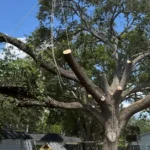
Topping — the practice of cutting the main trunk or major branches back to stubs — is not a legitimate pruning technique. It creates large, slow-healing wounds that invite decay, and the fast-growing sprouts that follow are weakly attached and more likely to break in the next storm. If a company recommends topping your tree, get a second opinion.
When Removal Is the Right Call
Sometimes the honest answer is that a tree needs to come down. Holding onto a hazardous tree out of sentiment or cost concern is a gamble with real consequences.
Removal is the right call when:
- The tree has significant internal decay, especially in the trunk or root zone
- The tree is leaning toward your home and the lean is worsening
- Fungal conks (shelf fungi) are present at the base, indicating advanced root rot
- The tree is a species known for storm failure in Florida — Australian pine, water oak, or an aging laurel oak past its prime
- The tree has already partially failed (large branch splits, major crack in the trunk)
- A professional arborist has evaluated it and recommended removal
The proximity factor: A tree that might be “watch and wait” if it were 100 feet from your house becomes a removal candidate when it’s 30 feet away and tall enough to reach your roof.
The In-Between: When It’s Not Clear-Cut
Some trees land in a gray zone — not obviously fine, not obviously dangerous. For these, a professional risk assessment is the most valuable tool you have. An arborist can evaluate:
- Internal decay using a mallet test or resistograph drill
- Root health and soil conditions
- Structural defects that aren’t visible from the ground
- The tree’s failure history and species-specific storm data
In some cases, the answer is structural support — cabling or bracing systems that help hold a tree together through storms. This works for specific situations and buys time for trees with sentimental or significant monetary value.
Cost Isn’t the Only Factor — But It Matters
Trimming is almost always less expensive than removal. That said, it’s worth running the numbers against the alternative. If a large tree causes major structural damage to your home, a typical insurance claim runs into the tens of thousands — and that assumes your policy covers it.
Pre-hurricane removal is consistently one of the most cost-effective decisions a homeowner can make when the risk is real.
The Bottom Line
- Healthy tree with hazardous branches? → Trim it.
- Compromised tree near your home? → Remove it.
- Not sure? → Get a professional assessment before hurricane season. That’s exactly what we’re here for.
We serve Pasco County, Hillsborough County, and the surrounding Tampa Bay area. If you’re weighing this decision, give us a call and we’ll walk the property with you.