Trees are more than just landscape features—they’re part of your property’s character and your family’s memories. Maybe you’ve watched your kids climb that oak for years, or you love the shade your maple provides during Florida’s scorching summers.
So when do you make the tough call to remove a tree? Nobody wants to say goodbye to a beautiful tree unnecessarily, but ignoring serious warning signs can put your home and family at risk.
Let’s talk about the six key indicators that it’s time to call in a professional arborist for a tree assessment—and possibly a removal.
Sign #1: The Bark Is Telling You Something
Your tree’s bark is like its skin—when something’s wrong inside, you’ll often see signs on the outside.
What to Look For:
Peeling or Flaking Bark
- Some species (like sycamores and birch) naturally shed bark—that’s normal
- But if your oak or pine is losing large sections of bark, that’s a red flag
- Look for areas where the bark is completely gone, exposing bare wood underneath
Cracks and Splits in the Trunk
- Deep vertical cracks, especially on the main trunk
- Splits that run horizontally around the tree (very concerning!)
- Wounds that aren’t healing or are getting larger
The Scratch Test Gently scratch a small piece of bark off a twig. Under the bark, you should see a greenish or cream-colored layer (the cambium). If it’s brown and dry, that branch is dead. Try this on several branches in different parts of the tree.
In Florida’s humid climate, damaged bark also invites fungal infections and insect infestations that can quickly compromise the entire tree.
Sign #2: Fungus and Mushrooms at the Base
See mushrooms growing around the base of your tree? Don’t just brush them off as a quirky lawn feature—they’re actually warning you about serious internal decay.
Why This Matters:
Mushrooms are the fruiting bodies of fungi living inside your tree. Their presence means:
- Wood-decaying fungi are actively breaking down your tree’s structure
- The decay might be extensive (fungi can spread through the tree for years before producing visible mushrooms)
- The tree’s structural integrity is compromised
Common Fungi in Pasco and Hillsborough County:
- Artist’s conk (looks like hard, woody shelves)
- Turkey tail (colorful, fan-shaped clusters)
- Honey mushrooms (tan/golden caps around the base)
Not all fungi are death sentences, but they always warrant a professional assessment.
Sign #3: Cavities and Hollow Areas
Large holes or hollow sections in the trunk or major branches are significant concerns.
A hollow tree is like a weight-bearing column that’s been partially hollowed out—it’s structurally weakened in ways that aren’t always visible from the outside.
Where to Check:
- The main trunk at ground level
- Major branch unions (where large branches connect to the trunk)
- Old wound sites where branches were previously removed
How Much Hollow Is Too Much?
- Trees can handle some hollowing (they’re surprisingly resilient!)
- If more than 30% of the trunk circumference is compromised, it’s concerning
- Location matters—hollowing on the side facing your house is especially risky
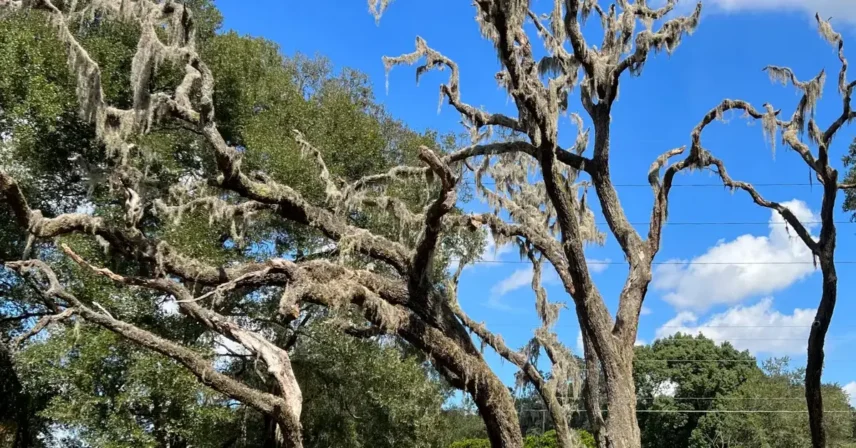
Sign #4: Dead or Hanging Branches in the Crown
Look up at your tree’s canopy. What do you see?
Dead Branches
- Branches without leaves during growing season (May-September in Florida)
- Brittle, dry branches that snap easily
- Large dead sections concentrated in one area
Hanging or Broken Branches
- Branches that are partially broken but still attached (called “widow makers” for good reason!)
- Limbs resting on other branches
- Heavy branches that have split but not fallen
Sparse or Thinning Canopy
- Significantly fewer leaves than in previous years
- Leaves only at the very tips of branches
- One side of the tree noticeably thinner than the other
In Florida, we expect lush, full canopies during the growing season. If your tree looks sparse or has large dead sections, something’s wrong.
Sign #5: No Spring Buds or Summer Leaves
In Florida, here’s what to expect:
- Early Spring (March-April): Most trees should show new buds swelling
- Late Spring (April-May): Leaves should be unfurling
- Summer (June-August): Full, lush canopy
Red Flags:
- By late May, your tree still has no leaves
- Fine twigs at the branch tips are dry and brittle with no buds
- Other trees of the same species in your neighborhood are fully leafed out, but yours isn’t
Some trees leaf out later than others, and Florida’s weather can delay things. But if it’s July and your tree is still bare, that’s a major concern.
Sign #6: The Tree Has Significant Lean
A tree that’s leaning wasn’t necessarily planted crooked—sometimes lean develops over time due to root damage, soil erosion, previous storm damage, or uneven weight distribution.
When Lean Is Dangerous:
Sudden Changes:
- A tree that was straight last year but is noticeably leaning now
- Lean that increased after a recent storm
- Soil heaving or cracking on one side of the tree (indicates root failure)
Severe Angle:
- Lean greater than 15 degrees from vertical
- Lean toward a house, garage, or other structure
- Lean toward areas where people gather (driveway, sidewalk, pool area)
Root Plate Movement:
- Soil mounding or cracking around the base
- Exposed roots on one side
- The tree “rocks” when you push on it
Here in Pasco and Hillsborough County, our afternoon thunderstorms and occasional hurricanes can suddenly reveal trees with compromised root systems. If your tree is leaning after a storm—even if it seems stable—get it assessed ASAP.
What to Do If You Spot These Warning Signs
Don’t panic, but don’t ignore them either.
Step 1: Document What You See
Take photos from multiple angles, note when you first noticed the issue, and track any changes over time.
Step 2: Call a Certified Arborist
A certified arborist can properly diagnose tree health issues, assess structural risks, determine if the tree can be saved, and provide expert recommendations.
Step 3: Act Quickly If There’s an Immediate Hazard
If your tree has large dead branches over your house, significant lean toward structures, major storm damage, or visible structural failure—this is an emergency. Contact us immediately.
Can Diseased or Damaged Trees Be Saved?
Sometimes, yes! Not every warning sign means automatic removal. Depending on the extent of damage, the tree’s species and age, and your goals, we might recommend:
- Strategic pruning to remove only dead or dangerous sections
- Cabling or bracing to support weakened branches
- Treatment for specific diseases or pest infestations
- Monitoring to track changes over time
But these interventions only work if we catch problems early. The longer you wait, the fewer options we have.
Think Your Tree Might Need Attention?
Don’t wait until a branch falls or a storm brings the whole tree down. Call Grand Oaks at (813) 592-5977 for a free tree risk assessment in Pasco and Hillsborough County.